Irish guide
IPTV Providers Ireland: How to Judge Any Seller Before You Pay
Search for IPTV providers Ireland-wide and the first results look much the same: a green banner, a huge channel count, a price and a WhatsApp button. This guide sets the promises aside and shows how to judge any seller on what you can check before money moves: the questions to send, the end date and refund rule in writing, the way you pay, who answers and when, and the records to keep.
IPTV providers Ireland: what to settle before you pay
Among the IPTV providers Ireland buyers find in a search, channel counts run into the tens of thousands and are almost impossible to verify from outside. The paperwork is different. An end date, a refund rule and a payment route can all be read before you spend a cent, and they decide how the sale goes if something fails.
Everything below applies to us as much as to anyone else. Where it helps, we describe how we work so you have a worked example rather than a verdict; the IPTV Ireland plans and line check are on our home page if you want to hold them up against the same checks.
Questions to send any seller, and what a clear answer sounds like
Send the same questions to each of the IPTV providers Ireland homes are weighing up, and send them in writing, by WhatsApp or email, so the replies stay on record. A promise made on a phone call is hard to point to later.
| Question | A clear answer | A reply that should worry you |
|---|---|---|
| When does my access end? | A calendar date, or a rule that gives one (twelve months from payment), written in the login message | ‘It doesn’t expire’, or no date at all |
| What is your refund rule? | A number of days, the cases it covers and where the money goes back | No number of days, or an answer that shifts when you ask again |
| How can I pay? | Card on a payment company’s secure page, or PayPal | Only transfer, gift cards or crypto |
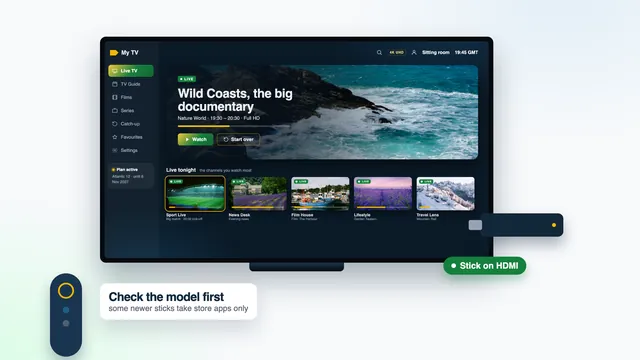
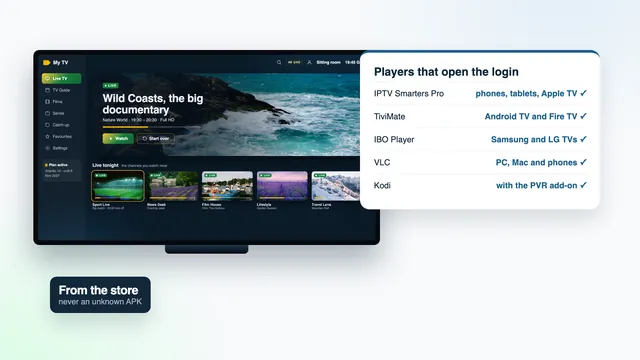
| Which apps open the login? | Named players, plus the login types: Xtream Codes and an M3U link | ‘Every device’, with no app named |
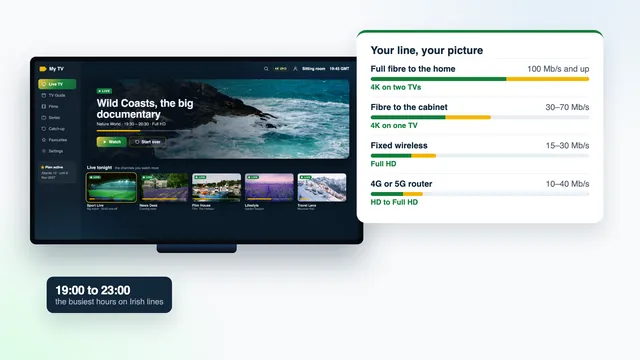
| My line is fixed wireless, about 20 Mb/s in the evening. What will it play? | Full HD on one TV, with 4K unlikely on that line | ‘Everything in 4K’, whatever the line |
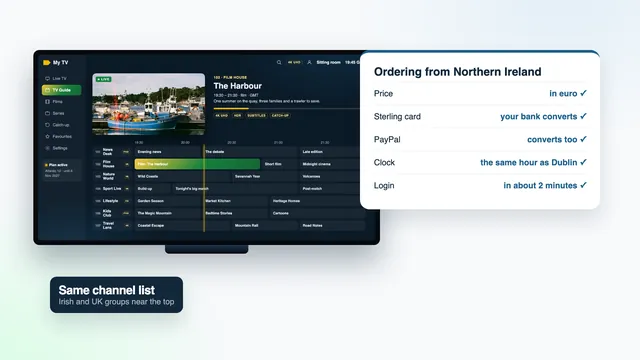
| Which time does the programme guide use? | Irish time: GMT in winter, IST in summer | No idea, or a guide set to another country’s clock |
| Who answers if it stops at 21:00 on a Sunday? | Named channels and hours, in English | Office hours only, or no hours stated |
The fifth question is the most revealing, because its correct answer is less flattering than ‘everything in 4K’. On fixed wireless at 15–30 Mb/s one plan plays Full HD, while 4K needs about 25 Mb/s, steady, on each screen. A seller who tells you that is telling the truth when it does not help the sale.
Our broadband guide for Irish lines sets out what full fibre, fibre to the cabinet, fixed wireless and 4G or 5G routers usually hold in the evening, so you can judge the answer for yourself.
What a written end date and refund rule look like
A written end date is a calendar day tied to your order, not a phrase like ‘one year’ in an advert. In our case it is printed in the login message beside the username and server details, and it follows from the day you pay: Atlantic 12 paid on 6 November 2026 ends on 6 November 2027, and Atlantic 3 paid the same day ends on 6 February 2027.
A refund rule is complete when it answers four questions: how many days, which cases, which exclusions, and where the money goes back. Ours, set out in full on the refund policy page, reads like this:
| Part of the rule | How ours is worded |
|---|---|
| How long | 7 days from the day you pay |
| What it covers | The login never arrived, or nothing displays on any screen even after the team’s help |
| What it leaves out | A change of mind, or broadband that cannot carry 4K when the speed it needs was explained first |
| Where the money goes | To whichever card or PayPal account was charged |
Hold any other seller’s rule up against the same four rows. A line such as ‘satisfaction guaranteed’ fills none of them, and a rule that exists only in a chat message is worth a screenshot the moment you see it.
Paying safely: card, PayPal and the routes to refuse
Most online card payments in the EU pass through your bank’s approval step, called Strong Customer Authentication and often known as 3D Secure: a prompt in your banking app or a code sent by text. It is a normal part of paying, not a sign that something is wrong. A refusal usually means the bank’s fraud screen stepped in; a tap of approval in the banking app, or a call to the bank, normally sorts it.
Paying by card also keeps a door open. When a service never arrives, the bank that issued your card may attempt a chargeback to reverse it. Time limits differ from bank to bank, so raise the problem with the seller first and keep their replies in case you need to show them.
PayPal lets you pay from your PayPal account or with a card you have added to it. Whether its buyer protection reaches a digital service is a question for PayPal’s current terms, so check those directly instead of taking a seller’s word for it.
The PayPal option meant for people you know
PayPal has a separate way of sending money to people you know personally. It is not designed for paying a business, and a seller who asks you to use it for an order is showing you a warning sign.
| Way of paying | What sits between you and the seller | Verdict |
|---|---|---|
| Debit or credit card on a payment company’s page | Your card issuer, with a chargeback where a service is not provided | Usual |
| PayPal, paying for an order | PayPal, under its current terms | Usual; read the terms |
| PayPal’s option for people you know | An option meant for personal payments, not businesses | Warning sign |
| Transfer, gift cards or crypto, with no other option | No card issuer and no PayPal account | Warning sign |
For reference, this is how we take payment: the team replies to your order with a secure payment link for debit or credit card or PayPal, and card details are typed on the payment company’s page, never sent to us. The name on your card statement is set by that payment company; ask the team and you will be told what to expect before you pay.
Warning signs that should stop a sale
None of these signs names anyone. They apply to all IPTV providers Ireland viewers come across, ourselves included, and any one of them is reason to slow down:
- a seller who takes nothing but bank transfer, gift cards or crypto;
- a ‘lifetime’ plan with no end date written anywhere;
- talk of refunds that never says how many days;
- silence, or a stock reply, to a question sent ahead of the sale;
- a request to pay through PayPal’s option for people you know;
- a price far below the going range on Irish offers, which our guide to IPTV prices in Ireland sets out.
‘Lifetime’ offers need a word of their own. They exist, they ask for a single payment, and nothing in writing says whose lifetime is meant: yours, the seller’s or the server’s. With no end date there is no length to measure what you were sold against, and no written guarantee to fall back on.
Support: language, hours and the speed of a reply
Trouble with IPTV in Ireland tends to show up in the evening. The rush on Irish broadband lasts from about seven until eleven at night, heaviest on Saturdays, Sundays and big match nights, so a help desk that shuts at six is closed exactly when you need it.
Ask three things: the language the team works in, the hours it answers and the channels it uses. Then let your pre-sale question check the claim. A specific reply at nine on a Sunday evening says more than any banner about round-the-clock help. It is also worth asking whether anyone will guide you through typing the login on the TV, or whether the message is the last you will hear.
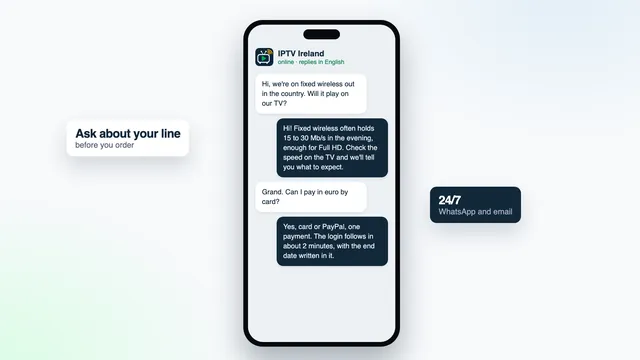
As a worked example, our team replies in English, 24/7, through WhatsApp or email, and you can send a question before ordering from the contact page. If you would rather set up alone, the IPTV Ireland setup guide covers each kind of screen.
The login, and a guide that runs on Irish time
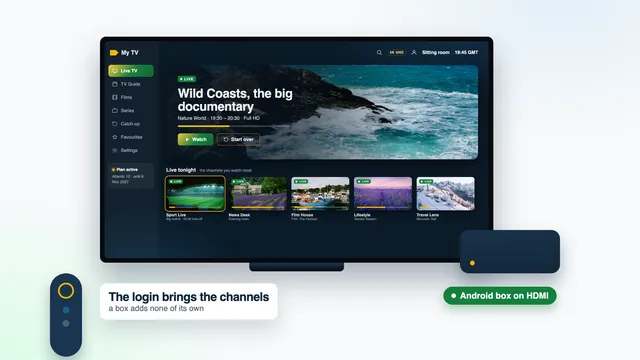
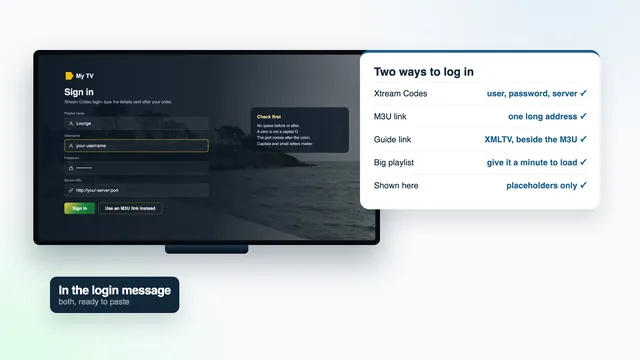
What arrives after payment should work in any compatible player, not only in one app or on one box sold alongside it. A complete login message carries four things:
- the Xtream Codes trio: username, password and server URL;
- a link to the M3U playlist;
- the XMLTV address that feeds the programme guide (the EPG);
- the date the plan ends.
If one is missing, ask for it at once. The M3U and guide links matter most when you want to change player later; our M3U guide for Irish homes and the round-up of player apps show where each one goes.
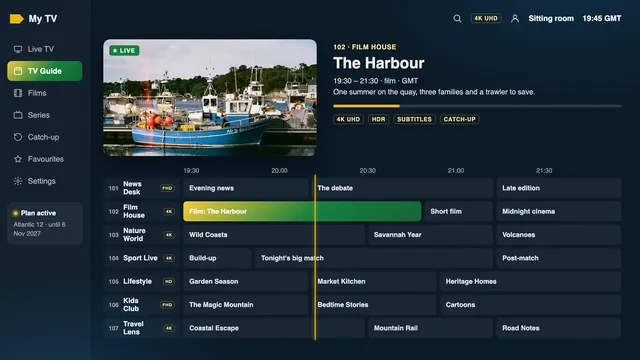
Then check the clock. Ireland keeps GMT through the winter, and Irish Standard Time (IST) runs from the final Sunday in March until the final Sunday in October, the same hour as the UK. A guide built on another country’s clock puts every programme in the wrong slot, which matters most on match days.
On 6 November 2026 Irish clocks are on GMT; the next changes fall on 28 March 2027 and 31 October 2027. If a player shows the guide one hour out after a change, its ‘EPG time offset’ setting puts it right. Ask any seller which time their guide follows before you rely on it for a throw-in.
A checklist before paying, and the records to keep after
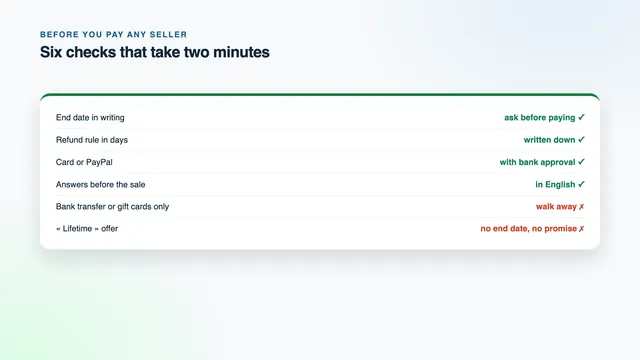
Fill in one copy for each of the IPTV providers Ireland searches turn up, and pay only where every row has a tick.
| Check | Where to find it | Ticked when |
|---|---|---|
| End date | Plan page or order chat | You have a calendar date, or a rule that produces one |
| Refund rule | Policy page or a written reply | It names the days, the cases and the way money comes back |
| Payment | The seller’s reply, then the payment link | Card on a payment company’s page, or PayPal; never transfer, gift cards or crypto alone |
| Reply before the sale | WhatsApp or email | A clear, specific answer in English |
| Support hours | Contact page | Evenings and weekends are covered |
| Your line | Speed measured on the TV or stick around 21:00 | You know whether it holds 25 Mb/s for 4K, or 10 for Full HD |
| Your players | The seller’s setup notes | An app is named for each screen in the house |
| Guide time | The seller’s answer | Irish time, GMT or IST |
When a seller passes, the order itself should be simple. Ours runs from choosing one of the four plans to a WhatsApp message with the plan already written. The IPTV subscription Ireland page lists what each plan includes, and the Android box guide helps if a screen in the house still needs a device.
Records to keep after you pay
Keep these together in one folder on your phone or in one email thread, from the day you pay until well after the end date:
- the order chat, showing the plan you chose and what it cost;
- the payment confirmation from the card payment page or PayPal, with its date and reference;
- the login message, which holds the end date;
- a screenshot of the refund rule as it read on the day you paid;
- if something fails, screenshots of the error with the time it appeared, and the replies you received;
- a calendar note a week before the end date, so the choice to order again is made in good time.
With those in hand, most problems become a short exchange rather than an argument. Should a disagreement go further, the Competition and Consumer Protection Commission (CCPC) is a source of consumer guidance in Ireland, and your card issuer will explain its own chargeback steps.
Ordering from the North? The Northern Ireland guide covers paying a euro price with a sterling card and the clock you will see in the guide.
Frequently asked questions
How do I check IPTV providers Ireland homes find online before paying?
Ask for the end date, the refund rule and the payment options in writing, then send one practical question about your own broadband line. Clear, prompt answers to all four give you a sound basis; vague replies or silence do not.
Is it a problem if a seller only accepts bank transfer?
Yes, it is one of the clearest warning signs. A transfer, a gift card or crypto puts no card issuer and no PayPal account between you and the seller if the login never comes. Choose a seller who takes card or PayPal.
What does ‘lifetime’ access actually give me?
Nothing you can hold a seller to. A lifetime offer has neither an end date nor a written guarantee, which leaves no length to compare, no cost per year, and no document to show anyone when the picture goes dark.
What name will appear on my card statement?
That name comes from the payment company rather than the shop, and the two may not match. Ask before you pay; our team will tell you what to expect.
Should a seller answer questions before I pay?
It should, and the speed and clarity of that answer is the most useful thing you can judge from outside. Our team takes questions before buying on WhatsApp and by email, in English, 24/7.
Where can I get consumer advice in Ireland?
The Competition and Consumer Protection Commission (CCPC) publishes consumer guidance for buyers in Ireland. For a card payment, your card issuer can explain how its chargeback process works and the time limits it sets.